Believe and you will achieve!

Believe and you will achieve!

Music For vocabulary...

Music For vocabulary...

Friday, 20 April 2018

English Listening skills/ how to train your ear - Part one :


Welcome to part one of a series of blog posts on how to improve your listening skills. I do hope that you find this mini lesson helpful.

Practice is essential as we all well know. One has to be disciplined and put in effort/make an effort... You do not have to spend hours each day in order to improve. Start with ten minutes per day and devote those minutes to listening to a short clip, the news or watching a short film. Try not to cram ( Do too much.) , essentially - you want to practice in short bursts - each day.  Do your future self a favour ! Start now. Listening to clips two or three times a week will not help - again : what we do daily, essentially matters most.

Bad habits are easy to create - why not nurture healthier habits? 

Here is a fabulous link to get you started:

https://www.englishlistening.com/listen

Why this website ? Well, all activities are filtered by accent, levels and topics - you are also able to choose the speed of speech. ( Most helpful for lower level learners / if you are starting out with practicing your listening skills. ) Try a free trial and see how you feel !

Free listening practice : 

http://www.elllo.org/


Let's begin :

English words confer meaning based on whether they are content or function words. Knowing the difference will help with both understanding and pronunciation:

Content = information, meaning

Function = necessary words for grammar


Function words and their role in speech  = purely there for grammatical purpose - such as : Articles ( a,an,the), Prepositions ( at/in/over.) , Auxiliary verbs ( do, has, will etc.) and Pronouns ( He, she, ours etc.) 

Content words and their role in speech:  - conjure up an image /a mental picture of something such as Adjectives/Nouns/Verbs and Adverbs

NOTE:

Content words are always enhanced/spoken louder - the function words are glided over. 

( This is apart from word stress itself where for example, words of two syllables : a noun is stressed on the first syllable and a verb,on the second. Eg: NOUN: OBject / Verb: obJECT.) 

See more about word stress: 
http://www.english-at-home.com/pronunciation/noun-and-verb-syllable-stress/


Let's try to practice : Read this aloud: 

The man ate the apple while sitting at the sea,it was a beautiful day and he was content !

Which words did you say louder ? Which words give you a mental image?

Can you point out the content words ? Which words do you think provide a word picture ? 
( Remember : Nouns, main verbs, adjectives and adverbs are usually content words. Auxiliary verbs, pronouns, articles, and prepositions are usually function/grammatical words.)

Now, read this : Man ate apple sitting sea, beautiful day -  content ! 

( We are still able to understand the meaning/gist of what is being said - this is why content words are spoken louder - they are the most important because they convey the message to our listener.) 

Tip when listening /watching movies : 

Start watching films with subtitles - this will help fine tune your ears to naturally spoken English. By following with subtitles - you will understand better when the following happens:


  • Contractions ( It is = It's/ They are = They're/What is = What's.)  
  • Varied accents ( i.e : American vs British/ Regional dialectical accent.)  -  where more elision/linking is used.

Examples of linking: What are = whaddah / could have = couldiv / where are you going / wherayagoin ? A lot = ahlod

Two main types of linking:

consonant ⇔ vowel
We link words ending with a consonant sound to words beginning with a vowel sound.
vowel ⇔ vowel

We link words ending with a vowel sound to words beginning with a vowel sound.


How do I improve? You ask... well = more listening ! 
Instead of listening to English “when you have the time”, do it whilst driving home, cleaning the house and even when doing some exercise. Download podcasts on your mobile phone - easy as pie ! 
Take a lesson or ten with me ! :) :) :) Movies with subtitles and short films are also reasonable. You have to do the work and train your ear ! Trust me, in time - it gets easier and soon, you will be able to get used to the way native speakers ''run through'' sentences. 


LET'S PRACTICE :

Try this exercise sourced from ThoughtCo.com :

https://www.thoughtco.com/

Exercise

Decide which words are function and content words in the following sentences.
  • Mary has lived in England for ten years.
  • He's going to fly to Chicago next week.
  • I don't understand this chapter of the book.
  • The children will be swimming in the ocean this time next week.
  • John had eaten lunch before his colleague arrived.
  • The best time to study is early in the morning or late in the evening.
  • The trees along the river are beginning to blossom.
  • Our friends called us yesterday and asked if we'd like to visit them next month.
  • You'll be happy to know that she's decided to take the position.
  • I won't give away your secret.
Check your answers below:


Exercise Answers
Content words are in bold.
  • Mary has lived in England for ten years.
  • He's going to fly to Chicago next week.
  • I don't understand this chapter of the book.
  • The children will be swimming in the ocean at five o'clock.
  • John had eaten lunch before his colleague arrived.
  • The best time to study is early in the morning or late in the evening.
  • The trees along the river are beginning to blossom.
  • Our friends called us yesterday and asked if we'd like to visit them next month.
  • You'll be happy to know that she's decided to take the position.
  • I won't give away your secret.

Sunday, 15 April 2018

Travel : Questions at the airport


    QUESTIONS YOU MAY HEAR AT AN AIRPORT:

May I see your ticket?

(The worker may also say, "Ticket, please.")
  • What's your purpose for travelling?

    (What is your reason for travelling? The worker wants to know if you are travelling for business or pleasure.)
  • Do you have a photo-ID?

    (driver's license, passport)
  • Are you checking any bags?

    (These are larger bags that the airline will store under the plane for you.)
  • How many bags are you checking?
  • Do you have a carry-on bag?

    (This is a small bag you take with you on the plane such as a purse, small suitcase, or laptop bag.)


QUESTIONS YOU MIGHT NEED TO ASK:


  • “Excuse me, where is the ___________<Insert name> Airlines check-in desk?”
  • “How many bags can I check?”
  • “Will my luggage go straight through, or do I need to pick it up in ______<Insert name>?”
  • “How much is the fee?”
  • If your bag is heavier than the weight limits, or if your bag is larger than the size limits, you may need to pay extra: an oversized baggage fee or overweight baggage fee (this can be $75 to $300). Some airlines in the United States also charge a fee for ALL checked bags (usually $15 to $30).
  • “Please mark this bag as ‘fragile.’”
    Say this if you have fragile or sensitive items in your bag that might break
  • “Is the flight on time?”
    The agent will respond either “Yes” if the flight is on time, or “There’s a 20-minute delay” (for example) if the flight will leave later than expected.


IN THE USA: SECURITY QUESTIONS


ALWAYS ANSWER YES :

  • Did you pack your bags yourself?
  • Has your luggage been in your possession at all times?
  • Are you aware of the regulations regarding liquids in your carry-on?
    (Liquids must be 100 mL or less, and stored in a single quart-sized clear plastic bag)

ALWAYS ANSWER NO:

  • Are you carrying any firearms or flammable materials?
  • Have you left your luggage unattended at any time?
  • Has anyone given you anything to carry on the flight?


ON THE PLANE:

Conversation Tips:

If you didn’t understand what the flight attendant said, you can say Sorry? or Pardon? to ask him or her to repeat it.
If you want to ask for something, you can use the phrase “Can I have…?” or “Could I have…?”

Credit : E.S.L Website

Holiday experiences : Lesson: Mixed tenses/Conditionals exercise :


Holiday experiences :

Basic tenses/ conditionals overview:

Using this form of the present perfect ''I have now + 3rd verb'' + Past Simple:
Example: I have now seen the famous leaning tower of pisa. We went on a Saturday – it was lovely !

5 new experiences and then add information:
1.
2.
3.
4.
5.


Relate 5 things you did and what made them special ( Past Simple.) :
Example: We visited a country estate, it was gorgeous because of the flowers !

1.
2.
3.
4.
5.


Can you tell me three things you would have done differently – use the 2nd conditional :


If I went/ did / were + I would/ could/ should have :
If I went to the new club, maybe I could have met Alanis Morissette – she was playing that night !

1.
2.
3.

Five items about a regret or a stroke of luck using the 3rd conditional :

Example of a stroke of luck :
If I had not visited the museum, I would not have seen the Mona Lisa.

Example of a regret : I got food poisoning – If I had not eaten so much sushi, I would not have felt ill that day !

1.
2.
3.
4.
5.


On my next holiday, I will / am going to :

Create 5 plans ( going to ) and 5 instant decisions ( will) and include a general truth/fact with the Present Simple:

Example of a plan and a fact : On my next holiday, I am going to go to Cyprus. In Cyprus people speak Greek, you know !
Example of an instant decision and a general truth: I think I will stay at an air bnb – I hear they are very good.

1.
2.
3.
4.
5.


1.
2.
3.
4.
5.


Sunday, 10 December 2017

Being polite in English : Part one


“Life is short, but there is always time enough for courtesy.” ― Ralph Waldo Emerson


Image result for being polite


Generally speaking,  people value being polite and respect good manners. A golden tip is that it is essential to utilize the three magical words of politeness in English :  “Please”, “Thank you,” and “Excuse me”.

Often, it is easy to simply say : ''What?'' as opposed to ''Excuse me?'' - my advice is that one should try to cultivate good habits through grading your communication style. 
  • What kind of language do you use when something is unclear / when you do not understand the question or statement ? 
When something is unclear or you misheard - ''What!'', is inappropriate - instead, simply say : 

  • ''Pardon me, I did not get that...''
  •  ''Excuse me, I do not think I understood.'',
  • ''Sorry, but could you repeat that ?''

It is common practice to say, ''Thank you.'' after your request has been fulfilled. 


Image result for being polite modal verbs


Moving on, it is best practice when making an appointment, a reservation, scheduling a meeting and even requesting something from your teacher - to say/ use one of the following:  

  • ''Please..........Thank you.''
  • '' Would it be possible to___________.''
  • ''May I please_________.''
  • ''Could I arrange________. Thank you.''.
  • I would like to _________ Thank you so much !''

Polite language goes a long way and will help you avoid any misunderstandings ! Notice how in English we use modal verbs such as ''could, would, May'' when making a polite request.  Being polite will make certain that service providers and co - workers want to help you with what you need ! 

Speaking tip: could and can are followed by the verb without to. 


Image result for providing meeting times i english


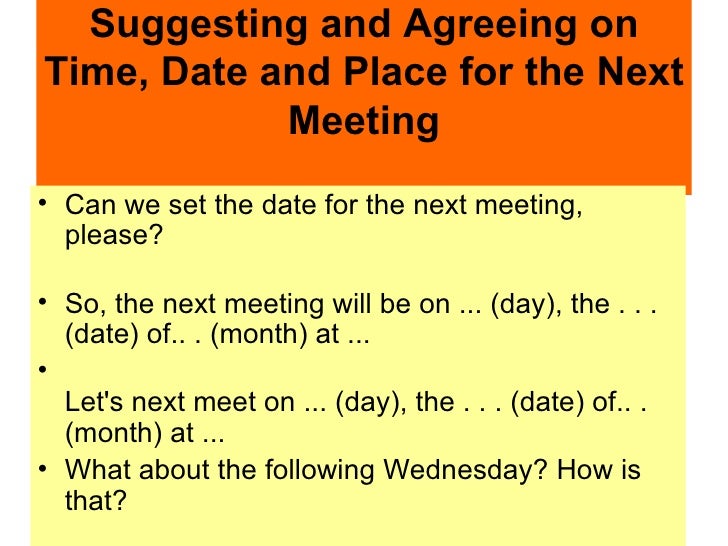
When you would like to schedule a meeting, it is essential to provide a few days and times, so that everyone is able to fit into your time slot/ agenda. Some useful language:

  • '' Would it be possible to meet on one of the following days:________''.
  • ''I would like to schedule a meeting/ book an appointment - would one of the following days be suitable at ________ time?'' ( Provide days.)
  •  '' How are you? / I trust all is well? I was wondering if we could move our appointment to another day - how about one of the following days:_________.'' ( In some cases, especially with regards to English lessons - regular classes are a prerequisite to improvement, so - rescheduling after a missed class is wise and fair for both the teacher and yourself ! )
  •  ''I can not make it today because _______, could we meet later this week - maybe on ______ ( provide day.) or _________( provide day.) at __________( provide a few times.) 

More polite language tips/ expressions:

To maintain good relationships, it’s best not to use imperatives (starting a sentence directly with a verb like “Reply to my e-mail,” “Go to the bank,” “Finish this project.”)

Instead, make requests with the phrases, Could you…? and Could you please…?

Register in writing  : It is rude to write/ type several question marks after a request : Example: What is the time???? / and rude to message just question marks sans wording : Example: ?? ( NEVER follow up a formal request via message or e - mail with just question marks - rather : ''I am just checking in to see if my message was received.''/ ''Are the days and times provided, suitable? Thank you for your response.''


“Let me know” is a nicer and more indirect way to say “tell me.” It’s a casual way to ask for some information. Alternatively, you could simply ask the question, “When are you available?

If you happen to be early for an appointment, be patient and wait - you will be seen to in good time. Use the 5 minute rule when waiting for a doctor's appointment, an interview or any other such event where the person you are meeting may have back to back clients and a slight delay. 

''Patience is a virtue.''.


Thank you so much for reading my post ! Do share : What is polite in your language / culture ? 

Thursday, 8 June 2017

Adverbs and Adjectives ( A request ! :) )

Hello dear students, 

It has indeed been a while since my last blog post...life has gone on and times have been eventful as they must be and will be. How have you been ? 

I trust that your journey to fluency has been eventful, enjoyable and most of all, a learning experience that awakens the very soul ! 

Remember to be good to each other - may the learning and teaching proceed... today, I present to you: 

ADVERBS AND ADJECTIVES : 


Adverbs:

Adverbs are used to give us more information about an action verb. How something happens or is done. 

For example:

'She cried loudly when the cat died'.
'He easily climbed the wall'.

Many English adverbs end in –ly. They are often made by adding –ly to the end of an adjective: quick + ly = quickly.

Be careful!

Sometimes adjectives end in –ly. For example:
friendly, lonely and lovely.

Adjectives:

Adjectives are used to tell us about nouns. They tell us about people and things.

'That was a bad film'.
'My exam was easy'.

Adverb + Adjective:

Adverbs can be used with adjectives. Take a look at the following examples:

adverb+adjective
extremely expensive
incredibly surprised
reasonably good
Astronomically high

Linking Verbs
LIST
to appear
to be
to become
to feel
to get
to go
to grow
to look
to prove
to remain
to seem
to smell
to sound
to stay
to taste
to turn

USE
The linking verbs above are often followed by adjectives instead of adverbs. In such situations, the adjective describes the subject of the sentence rather than the verb.


TIPS::

Look at the context

If you're not sure whether to use an adverb or an adjective, try to figure out what you're describing. Remember, adjectives are used to describe nouns, which means they can explain what kind of thing you have, how many things you have, or which thing you're talking about.

Adverbs, on the other hand, are used to describe verbs, which means they can explain how something happened, when something happened, or where something happened.


Look at the placement:

Here's an easy way to know where to put an adjective in a sentence. It will usually appear just before the noun it's describing. By contrast, an adverb will usually appear right after the verb it's describing.
Unfortunately, placement doesn't always tell you if something is an adverb or adjective. For example, is sassy an adjective or adverb in the image below?


Even though it's right next to a verb (is), sassy is an adjective because it describes the magician. And while adjectives are usually close to the words they describe, adverbs can move around more freely in a sentence. For example, you might see an adverb at the beginning of a sentence.


Here, frankly is an adverb, but it doesn't describe any specific verb in the sentence. Instead, it means the entire sentence will be spoken in a frank, or direct, way. If he was more optimistic, he might have said, Hopefully, it will all work out.


Now read the following sentences and decide if an adverb or adjective is needed:

Relax. He's a ___ driver.
safe
safely

Your brother is so ___.
kind
kindly

I always work ___ during the week.
hard
hardly

You ___ touched your lunch.
hardly
hard

At the party everyone was ___ dressed.
beautiful
beautifully

By the time we got home I was ___ tired.
terribly
terrible

Han did ___ on his test.
badly
bad

I baked this cake ___ for you.
special
specially

They have been ___ married for years.
happily
happy

It's natural to feel ___ before a job interview.
nervously

nervous